
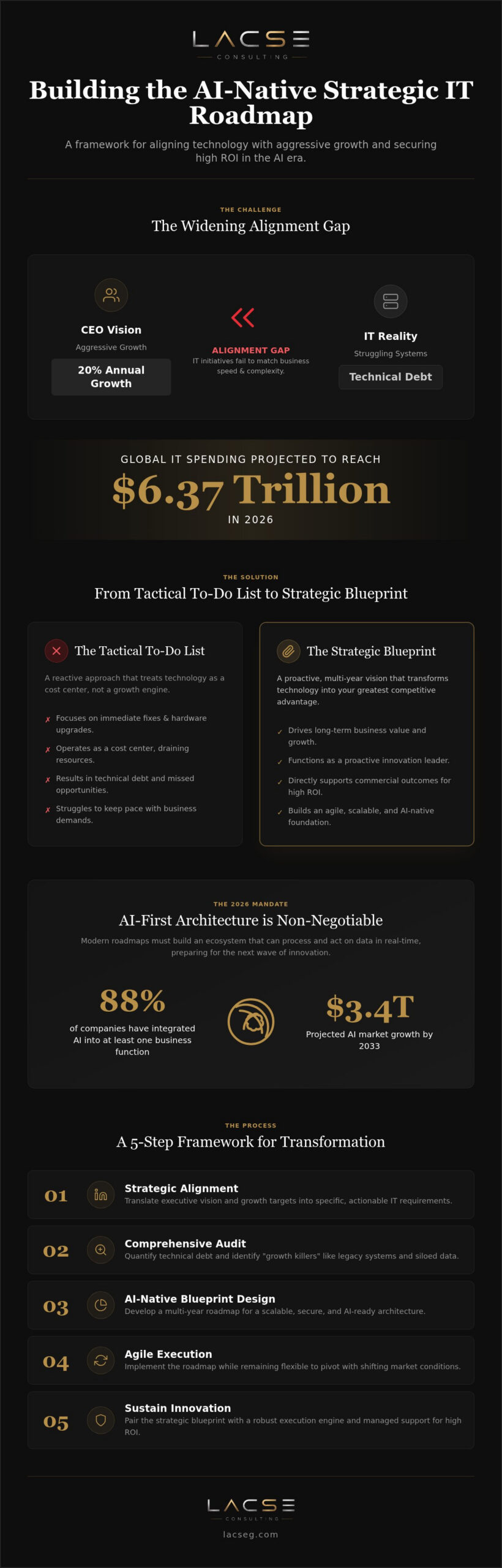
With global IT spending projected to reach a staggering $6.37 trillion in 2026, the margin for error in technology investment has vanished. You’ve likely felt the mounting pressure to deliver aggressive growth while your current systems struggle under the weight of technical debt. It’s a common frustration. Many leaders find themselves trapped in an alignment gap where IT initiatives don’t quite match the high-speed expectations of the CEO, especially as AI complexity increases.
Mastering strategic IT roadmap development is no longer just about listing hardware upgrades; it’s about building an AI-native blueprint that drives measurable business value. This guide provides the framework you need to align technology with your long-term vision. We’ll show you how to integrate AI into existing workflows, eliminate the drag of legacy systems, and secure a high ROI on your digital transformation projects. You’ll gain a clear, multi-year plan to move from maintaining infrastructure to leading innovation. We’ll explore the specific steps to turn your technology stack into a proactive engine for growth and operational efficiency.
Key Takeaways
- Distinguish between a tactical “to-do list” and a high-level strategic growth document to ensure your technology serves your long-term vision.
- Bridge the “Alignment Gap” by translating aggressive business goals, such as 20% annual growth, into specific, actionable IT requirements.
- Master a proven five-step execution framework for strategic IT roadmap development that prioritizes AI-native architecture and rapid scalability.
- Identify and neutralize “growth killers” like legacy systems and siloed data through a comprehensive audit of your current technical debt.
- Sustain innovation by pairing your strategic blueprint with a robust execution engine and ongoing managed support to ensure high ROI.
Strategic IT Roadmap Development: Defining the Modern Blueprint
A strategic IT roadmap development process is not a mere shopping list for hardware or a schedule for software patches. It is a high-level, multi-year vision that dictates how technology will drive your organization toward its most ambitious goals. While a tactical plan focuses on immediate fixes, a strategic document focuses on long-term growth. It serves as a bridge, translating high-level business objectives into precise technical execution. Without this connection, technology remains a cost center. With it, technology becomes your most powerful competitive advantage.
A comprehensive technology roadmap ensures that every dollar spent on infrastructure directly supports a specific commercial outcome. In the 2026 business climate, this alignment is non-negotiable. Leaders who fail to connect their technical stack to their revenue targets find themselves trapped by technical debt and missed opportunities. Success requires a document that is both visionary and actionable, providing a clear path from your current state to your future capabilities.
The Shift from Maintenance to Innovation
Modern enterprises can’t afford to just “keep the lights on.” Reactive IT is a liability that drains resources without adding value. Transitioning to a proactive model means your technology stack anticipates business needs before they become bottlenecks. This shift improves operational efficiency by automating routine tasks, allowing your team to focus on high-value transformation projects. When IT leads innovation, the entire organization gains the agility needed to pivot in a volatile market. It’s the difference between struggling to catch up and setting the pace for your industry.
Why 2026 Roadmaps Require AI-First Architectures
AI is no longer a peripheral feature or a shiny add-on; it’s a foundational infrastructure requirement. Recent data shows that 88% of companies have integrated AI into at least one business function as of 2025, and that number is only climbing. A modern roadmap must prepare data environments for machine learning and predictive analytics from the ground up. You aren’t just adding an AI tool. You’re building an ecosystem that can process and act on data in real-time. AI-First Roadmapping is the integration of intelligent automation into every layer of the IT stack. This approach ensures your architecture is ready for the projected $3.4 trillion AI market growth expected by 2033. By prioritizing AI-native planning, you ensure your investments remain relevant as the technology continues to evolve at breakneck speed.
Strategic Alignment: Bridging the Gap Between Vision and Velocity
The “Alignment Gap” is the silent killer of digital transformation. CEOs often view IT as a sluggish cost center, while CIOs feel they’re constantly fighting fires with insufficient resources. This disconnect happens when technology isn’t explicitly tied to revenue. Effective strategic IT roadmap development requires a shared language that translates high-level ambition into technical capability. If the goal is 20% annual growth, your roadmap must detail the exact infrastructure required to handle that surge in transactions and data without compromising performance.
Securing C-suite buy-in isn’t about explaining server specs; it’s about demonstrating how a specific technology investment accelerates market entry or slashes operational costs. To maintain this momentum, leaders should adopt “Agile Roadmapping.” This approach allows you to stay committed to the long-term vision while remaining flexible enough to pivot when market conditions or AI capabilities shift. Using a structured strategic roadmap template helps standardize this communication across departments, ensuring accessibility and clarity for every stakeholder involved in the decision-making process.
Translating Executive Vision into Technical Requirements
Uncovering true business drivers requires more than a survey. It demands deep-dive interviews with department heads to identify where current systems create friction. If the sales team needs to expand into new territories, your roadmap must prioritize global network scalability and localized compliance tools. We map these revenue goals directly to software capabilities. Technology should always be the catalyst for expansion. When you align your stack with the executive vision, you transform IT from a bottleneck into a high-velocity engine. For those struggling to bridge this divide, professional IT strategy consulting provides the external perspective needed to align these disparate priorities.
Prioritizing Value Realization and ROI
Every project on your roadmap must have a clear success metric tied to value realization. We don’t just track “uptime”; we track how digital transformation implementation reduces customer churn or increases employee productivity. Calculating the “Cost of Inaction” is equally vital. Sticking with outdated infrastructure might seem cheaper today, but the risk of data breaches and lost agility is a far greater financial burden. Balance your plan with short-term “quick wins” that build confidence and long-term foundational investments that ensure future-proof scalability. This dual-track approach ensures you deliver immediate value while building a legacy of technical excellence.
The Modern Audit: Quantifying Capability and Technical Debt
Strategic IT roadmap development begins with a brutal assessment of your current state. You can’t chart a course for the future while anchored to the past. Many leaders mistake a list of upgrades for a strategy. This error ignores the “Growth Killers” lurking in your infrastructure: legacy systems, siloed data, and critical security gaps. These aren’t just technical issues; they’re financial liabilities. Adopting a formal technology roadmapping process requires a clear understanding of the friction points within your existing architecture. By quantifying these weaknesses, you transform vague concerns into a prioritized list of strategic imperatives.
AI now plays a dual role in this phase. It isn’t just the goal; it’s the auditor. Intelligent tools can scan your environment to uncover hidden technical debt that manual reviews often miss. This debt acts as a speed limit on your innovation velocity. With the average cost of a US data breach reaching between $10.22 million and $11.5 million in 2026, failing to audit your security posture is no longer a risk; it’s a dereliction of duty. A modern audit provides the data needed to justify the investments that follow. It ensures your strategic IT roadmap development is rooted in reality, not optimism.
Identifying Legacy Constraints to Digital Transformation
Legacy systems are more than just old; they’re expensive. Outdated software drains IT budgets through high maintenance costs and prevents strategic reinvestment into growth-focused projects. We evaluate the risk of these systems within a competitive landscape. While a “rip and replace” approach offers a clean slate, it isn’t always feasible. A phased modernization strategy allows for a controlled transition, mitigating operational risk while steadily reducing technical debt. This ensures your budget supports your future, not your history. Understanding when to hire an IT consultant to guide this modernization process can be the critical factor that determines whether your transition succeeds or stalls.
Capability Mapping for Future Scalability
Infrastructure is only as effective as the people managing it. We assess your current team’s ability to handle AI and cloud technologies to identify critical skill gaps. These gaps are often the invisible barriers to rapid scaling. One of the most consequential decisions you’ll face is understanding the true tradeoffs of IT consulting vs in-house IT when building the human foundation your roadmap requires. Creating a “Readiness Scorecard” provides a clear metric for your organizational digital maturity. This scorecard measures technical readiness and cultural agility. It ensures that when you deploy new capabilities, your team is prepared to extract their full value. Scaling fast requires a foundation that is both technically sound and human-ready.
The Execution Framework: A 5-Step Blueprint for Transformation
The audit has exposed the cracks; now we build the structure. A successful strategic IT roadmap development process requires a disciplined execution framework to turn high-level vision into operational reality. This five-step blueprint ensures your technology investments aren’t just modern; they’re transformative. We move from identifying debt to creating assets that drive aggressive growth. By following this structured path, you ensure that every technical deployment serves a measurable commercial objective.
Phase 1-2: Discovery and Objective Setting
The journey begins with Strategic Discovery. We uncover business-critical goals and constraints by looking beyond the IT department to the commercial pressures facing your organization. You must align with the “AI World” by identifying exactly where automation adds immediate value to your bottom line, whether through customer service bots or predictive supply chain tools. We set “North Star” objectives that guide every subsequent technical decision, ensuring no project is launched without a clear purpose. Architecture Design follows, where we build an AI-integrated foundation that supports massive data throughput and real-time processing. Initiative Sequencing is the strategic ordering of projects to maximize cumulative ROI. This phase ensures that your most vital projects receive the attention they deserve while maintaining a logical flow of technical dependencies.
Phase 3-5: Architecture, Implementation, and Governance
Phase three moves from theory to structure. We design for interoperability and data security across the entire enterprise, ensuring that new AI tools communicate with legacy databases securely. Resource Allocation is the fourth step; you must budget for both the initial implementation and the ongoing support required to maintain peak performance. This involves a strategic mix of capital expenditure for new infrastructure and operational expenditure for ongoing support. Finally, we establish Governance and Evolution. A roadmap is a living document, not a static PDF. Establishing a “Roadmap Governance” board to review progress quarterly allows you to incorporate feedback loops. These loops ensure your strategy adapts to market shifts and emerging technologies like generative AI. This proactive approach prevents your roadmap from becoming obsolete before the first phase is complete. Move from planning to performance with our digital transformation implementation services.
Sustainable Innovation: Integrating Strategy with Managed Excellence
A visionary document is only as effective as the engine driving it. Without a robust execution framework, even the most sophisticated strategic IT roadmap development remains a theoretical exercise. You’ve likely seen projects lose momentum as daily operational fires consume the resources meant for innovation. Sustainable growth requires a shift from sporadic upgrades to continuous optimization. This is where the synergy between high-level consulting and boots-on-the-ground support becomes your greatest asset. Execution is the bridge between a plan and a profit.
We view ongoing IT support as the essential maintenance crew for your strategic vision. It isn’t just about fixing broken hardware; it’s about ensuring your infrastructure remains capable of supporting the AI-native goals established in your roadmap. When your technical foundation is solid, your growth initiatives have the stability they need to scale. This stability also fuels your outward-facing efforts. There’s a profound connection between IT infrastructure and digital marketing performance. A fast, secure, and data-rich environment is the prerequisite for effective SEO and high-conversion marketing campaigns. If your backend lags, your front-end growth will follow suit.
Integrating Managed Services for Long-Term Success
Roadmap decay is a real threat to modern enterprises. It happens when technical regression and unmanaged debt slowly pull your systems away from your strategic targets. Ongoing managed services prevent this slide by providing continuous monitoring and proactive adjustments. Partnering with a single firm for both strategy and implementation eliminates the friction of handoffs. You gain a partner who understands the “why” behind every “how.” This integrated approach ensures that operational efficiency isn’t a one-time achievement but a permanent state of being. We optimize your environment in real-time to match the velocity of your business goals.
LACSE Consulting: Your Partner in Digital Evolution
We don’t just provide “IT help”; we act as your high-performing ally in a complex digital landscape. By leveraging advanced AI tools and deep technical expertise, we deliver tailored business IT solutions that are as unique as your organization. Our role is to be the visionary guide that keeps you ahead of the curve, combining bold innovation with a grounded, methodical approach to problem-solving. We’re deeply invested in your long-term success, moving beyond reactive support to drive proactive transformation. It’s time to turn your technology from a burden into a competitive engine. Partner with LACSE for your strategic IT roadmap to secure your future in the AI era.
Secure Your Competitive Edge through Strategic Precision
The transition from a reactive cost center to a proactive growth driver requires more than just new software. It demands a fundamental shift in how you align technical capabilities with executive vision. By auditing legacy constraints and building an AI-native foundation, you ensure your organization is prepared for the rapid shifts of the 2026 business landscape. Mastery of strategic IT roadmap development is the only way to turn technical debt into a scalable asset that fuels long-term innovation.
LACSE Consulting serves as your high-performing ally, offering national reach and deep expertise in AI-powered digital transformation. We provide an integrated approach that seamlessly combines high-level strategy, precise implementation, and ongoing managed support. This ensures your blueprint doesn’t just sit on a shelf; it delivers measurable ROI and operational excellence. It’s time to stop fighting legacy fires and start leading your industry with technical confidence. Drive your business forward with a custom Strategic IT Roadmap from LACSE Consulting and transform your technology into a permanent engine for growth.
Frequently Asked Questions
What is a strategic IT roadmap and why does my business need one in 2026?
A strategic IT roadmap is a high-level vision connecting technology to business outcomes. In 2026, with IT spending projected up to $6.37 trillion, you can’t afford aimless investment. It prevents technical drift and ensures every dollar spent on infrastructure supports aggressive growth. Without it, you’re just reacting to problems rather than leading with innovation. It’s the difference between a sluggish cost center and a high-velocity competitive engine for your organization.
How often should an IT roadmap be updated to remain relevant?
You should review your roadmap quarterly and perform a deep update annually. The pace of AI advancement in 2026 makes static five-year plans obsolete. A quarterly review allows you to pivot based on market shifts or new technical capabilities while keeping your “North Star” goals in sight. This cadence ensures your strategic IT roadmap development remains a living process that adapts to real-world performance data rather than becoming an outdated technical document.
What is the difference between an IT roadmap and a product roadmap?
An IT roadmap focuses on the internal infrastructure and systems that power the entire organization. A product roadmap is specifically for the features and timeline of a customer-facing offering. While they overlap, the IT roadmap provides the foundation, like cloud scalability and data security, that allows the product team to build and launch features. One is the engine room; the other is the vehicle’s dashboard. Both must align to ensure business success.
How do I align my IT strategy with my business growth goals?
Start by translating revenue targets into technical capacity requirements. If you’re targeting 30% growth, your infrastructure must handle the increased load without friction. We use deep-dive interviews with C-suite leaders to uncover true business drivers. This process ensures that every technical initiative, from cloud migration to AI integration, directly removes a bottleneck or creates a new revenue stream. Technology must always serve as a catalyst for expansion rather than a growth-limiting constraint.
What role does AI play in modern IT roadmap development?
AI is now both a foundational tool and a primary goal. It automates the auditing of your current technical debt and predicts future infrastructure needs. In 2026, 88% of enterprises use AI in at least one function, so your roadmap must treat it as core infrastructure. It’s no longer an optional add-on; it’s the framework that enables real-time data processing and automated operational efficiency across every layer of your existing technical stack.
How do I handle legacy systems when building a digital transformation roadmap?
We recommend a phased modernization strategy rather than a risky “rip and replace” approach. Identify which legacy components create the highest security risk or drain the most budget. You can then prioritize these for migration while keeping stable systems running. This method reduces operational risk and allows you to reinvest maintenance savings into growth-focused projects. You’ll steadily lower your technical debt over a multi-year period while maintaining the stability of your core operations.
What are the most common mistakes in IT roadmap execution?
The biggest failure is treating the roadmap as a static “to-do list” rather than a strategic document. Other common errors include ignoring technical debt, failing to secure C-suite buy-in, and neglecting ongoing support. Without a strong execution engine, even the best plan will suffer from roadmap decay. Success requires a partner who provides both the high-level strategy and the strategic IT roadmap development implementation needed for sustainable innovation and long-term technical excellence. Knowing when to hire an IT consultant to fill critical expertise gaps is often the decisive factor between a roadmap that thrives and one that stalls.
Comments are closed