
By 2026, the traditional IT department will no longer exist as a mere support function. It’s either a high-velocity engine for growth or a quiet drain on your capital. Most executives recognize the exhaustion of chasing elite talent in a market defined by high turnover and specialized AI demands. You likely feel the tension of rising security risks and unpredictable spending that threatens your bottom line. The choice between IT consulting vs in-house IT isn’t just about labor costs anymore. It’s a fundamental decision about how fast your business can pivot toward innovation.
We understand that maintaining a competitive edge requires more than just keeping the lights on. This guide provides a strategic framework to master the critical differences between internal teams and external experts. You’ll learn how to optimize your operational velocity and secure predictable technology costs. We’ll explore the path to accessing elite digital transformation expertise while building a scalable IT infrastructure that grows alongside your enterprise. From AI integration to long-term strategic alignment, we’re outlining the roadmap for your technical future.
Key Takeaways
- Identify the core operational differences between maintenance-focused internal teams and growth-oriented strategic partnerships.
- Analyze the total cost of ownership (TCO) when evaluating IT consulting vs in-house IT, including hidden recruitment and training expenses.
- Secure immediate access to specialized AI and digital transformation expertise to bypass the challenges of the technical talent shortage.
- Execute a 5-step maturity audit to verify that your technical infrastructure can support aggressive 2026 growth targets.
- Explore the co-managed IT model as a way to supplement internal teams with high-level strategic guidance and implementation.
Decoding the IT Paradigm: Traditional In-House vs. Modern Consulting
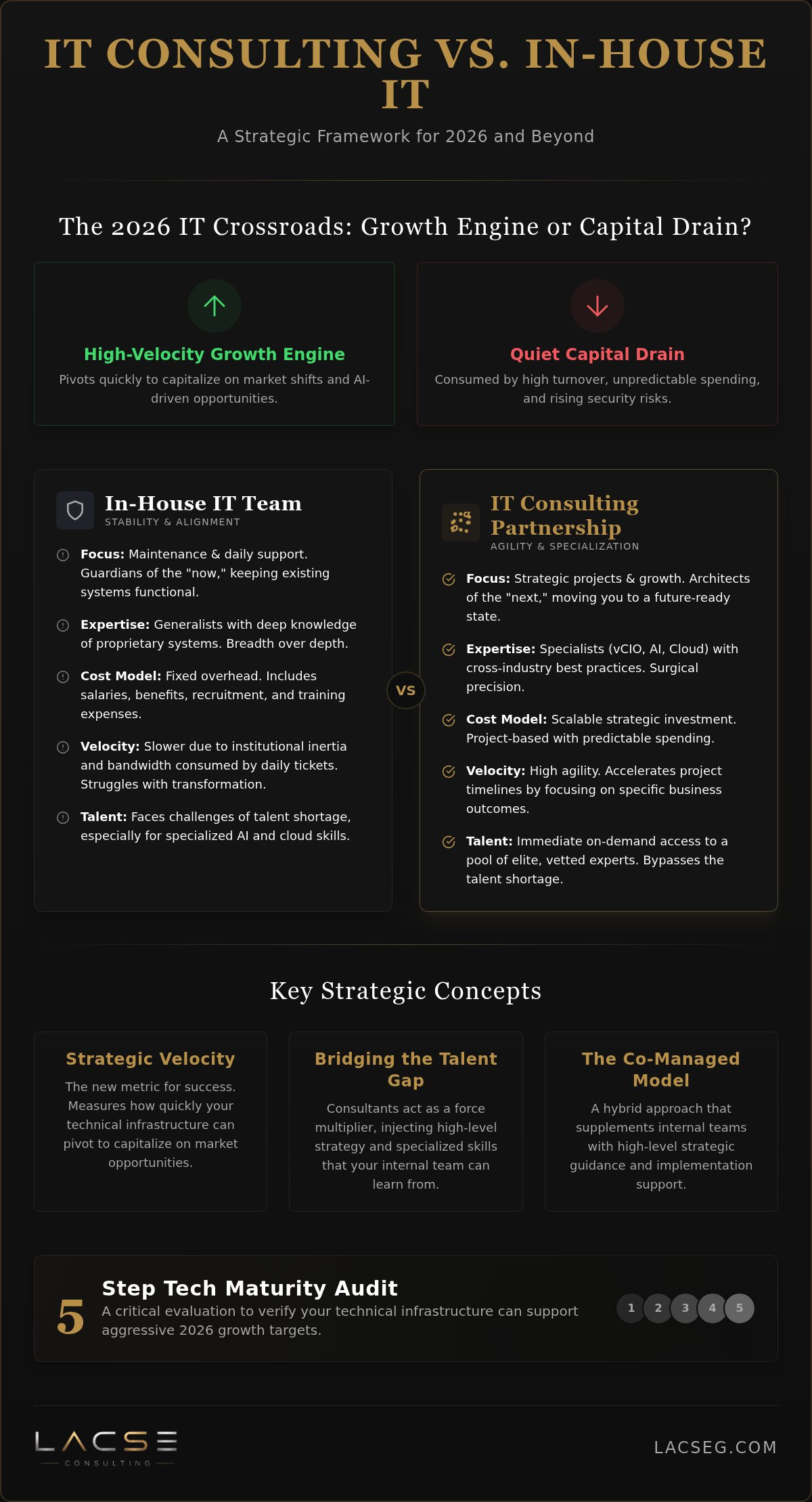
The binary choice of IT consulting vs in-house IT has evolved into a strategic crossroads. Historically, internal departments were viewed as cost centers buried in the back office, tasked primarily with fixing hardware and managing local networks. Today, technology is your primary revenue engine. This shift demands a new metric for success: Strategic Velocity. This concept measures how quickly your technical infrastructure can pivot to capitalize on market shifts and AI-driven opportunities. In 2026, the goal isn’t just stability; it’s the ability to move faster than your competitors.
An in-house IT team consists of full-time employees dedicated to your specific proprietary systems and daily maintenance. They are the guardians of your current state, ensuring that existing workflows remain functional. Conversely, IT consulting represents a strategic partnership. It provides specialized knowledge and project-based execution designed to move you from your current state to a future-ready position. While the internal team focuses on the “now,” the consultant focuses on the “next.”
The In-House Model: Stability and Cultural Alignment
Internal teams offer an immediate physical presence and a profound understanding of your company’s unique workflows. You maintain direct managerial control over every priority and personnel development path. This proximity fosters a deep cultural alignment that’s difficult to replicate with external parties. However, this model often faces institutional inertia. When your team is consumed by daily support tickets and routine patches, they rarely have the bandwidth to research, test, and implement rapidly evolving tech protocols. The result is a team that’s excellent at maintenance but struggles with transformation.
The Consulting Model: Agility and Specialized Depth
Strategic consulting provides on-demand access to high-level experts, such as vCIOs and AI integration specialists, without the burden of executive-level salaries or long-term benefits. These partners bring exposure to industry-wide best practices and diverse technology stacks that an internal team rarely encounters. The focus shifts from simply keeping the lights on to hitting specific project milestones and business outcomes. By leveraging external depth, you gain the agility to scale operations based on current market demands. This flexibility is the cornerstone of IT consulting vs in-house IT considerations for businesses aiming for aggressive growth. You aren’t just buying labor; you’re investing in a proven roadmap for digital advancement.
Specialized Expertise: The Battle for AI and Digital Transformation Talent
The competition for elite technical talent has reached a fever pitch. Finding and retaining experts in generative AI, machine learning, or complex cloud architecture is an uphill battle for most internal HR departments. When comparing IT consulting vs in-house IT, the talent gap is often the primary bottleneck for growth. In-house staff are typically generalists by necessity. They manage everything from hardware procurement to network troubleshooting. While this breadth is essential for daily stability, it lacks the surgical precision required for high-stakes modernization projects.
Consulting firms operate on a different plane of expertise. They employ specialists who live at the cutting edge of specific technologies. These experts bring proprietary tools and proven methodologies for legacy system migration that internal teams simply haven’t had the exposure to master. Instead of replacing your team, these consultants act as a force multiplier. They don’t just provide extra hands; they provide a higher level of thinking that accelerates your project timelines. They inject high-level strategy into your environment, allowing your internal staff to grow by observing best-in-class execution. It’s the difference between a general practitioner and a specialist surgeon; both are valuable, but you want the latter for a heart transplant.
Bridging the AI Knowledge Gap
Internal teams rarely have the luxury of research and development time. They’re swamped with support tickets and routine maintenance. This lack of bandwidth makes it impossible to vet and implement emerging AI tools effectively. Consulting firms leverage cross-industry data to predict implementation pitfalls before they occur in your specific environment. This allows for a smoother transition to AI-powered workflows that would otherwise remain out of reach for a standard IT department. This perspective is vital for modernizing outdated infrastructure without causing catastrophic downtime. Partnering for digital transformation implementation ensures your business remains competitive while your internal team maintains operational continuity.
Continuous Innovation vs. Technical Debt
Many in-house departments eventually transform into “firefighters.” They spend the majority of their budget and energy patching legacy systems and reacting to immediate crises. This reactive stance creates a mountain of technical debt that eventually halts innovation. Consultants provide the external pressure needed to break this cycle. They design roadmaps that prioritize long-term scalability over quick, temporary fixes. Digital transformation is a continuous evolution rather than a one-time project. By choosing the right balance in the IT consulting vs in-house IT debate, you ensure that your technology stack moves from a liability to a strategic asset.
Financial Architecture: Fixed Overhead vs. Scalable Strategic Investment
Managing a modern budget requires a shift from viewing IT as a utility to treating it as a strategic engine. When evaluating IT consulting vs in-house IT, many leaders focus solely on salary comparisons. This narrow view ignores the total cost of ownership (TCO) associated with internal teams. A full-scale IT department carries heavy baggage: recruitment fees, health benefits, retirement contributions, and dedicated office space. These are static costs that don’t shrink when your project load lightens. Selecting between IT consulting vs in-house IT determines whether your budget is a fixed anchor or a flexible sail.
Consulting fees offer a scalable architecture. You pay for high-level expertise during a major migration or AI rollout, then scale back to foundational support once the heavy lifting is complete. This elasticity ensures your capital isn’t locked into underutilized human resources. It allows you to reallocate funds toward innovation rather than just maintaining the status quo.
The most significant financial risk isn’t the fee itself; it’s the “Opportunity Cost of Delay.” In-house hiring cycles for specialized roles often stretch into months. During that time, your digital transformation stalls. Competitors who leverage consulting partnerships launch their AI initiatives while you’re still vetting resumes. Every week your project sits idle is a week of lost market share and delayed ROI. Speed is a currency, and consulting is the fastest way to spend it.
The Burden of Fixed Operational Costs
Fixed salaries create a rigid financial floor. During economic downturns or quiet operational periods, you’re still paying for the maximum capacity of your team. Additionally, turnover costs are staggering. Losing a senior engineer means losing institutional knowledge and spending thousands on headhunters and onboarding. Consultants mitigate this risk by providing a deep bench of talent that ensures continuity without individual employee lifecycle costs. They also audit your infrastructure to eliminate redundant licensing fees that often bloat internal budgets.
ROI and Strategic Alignment
Consulting shifts your technical spending from a necessary operating expense to strategic capital. Success isn’t measured by the lack of server downtime; it’s measured by how technology accelerates your business goals. This alignment ensures that every dollar spent on IT contributes directly to the bottom line. True IT ROI is the delta between technology cost and generated business value. By prioritizing growth metrics over mere uptime, you move away from the cost center mentality and toward a model of continuous advancement.
The Decision Matrix: Evaluating Your Organizational Tech Maturity
Choosing between IT consulting vs in-house IT requires more than a gut feeling. It demands a rigorous, data-driven audit of your current technical maturity. You must identify where your organization sits on the spectrum of stability versus transformation to ensure your 2026 goals remain achievable. This decision matrix simplifies the process by focusing on operational reality rather than theoretical benefits. Your current infrastructure complexity and five-year growth trajectory dictate the model that will serve you best.
Before committing to a structure, evaluate these five critical factors:
- Innovation-to-Maintenance Ratio: Is your team spending more than 70% of their time on routine tickets?
- Infrastructure Complexity: Can your current stack support immediate AI integration?
- Talent Redundancy: Do you have a backup for every critical technical role?
- Speed-to-Market: Does your current hiring cycle delay digital initiatives by more than 90 days?
- Scalability: Can your IT costs pivot instantly if your business scales by 50%?
Audit Step 1: Assessing Internal Capability
Does your team have the specialized skill set to lead a digital transformation, or are they optimized for daily support? Many small in-house teams suffer from a “single point of failure” risk. If your primary network architect leaves, your institutional knowledge vanishes overnight. This vulnerability is a major factor in the IT consulting vs in-house IT debate. You must also evaluate your current backlog. If strategic IT projects are gathering dust while the team fixes hardware issues, you’ve hit a functional ceiling. A stagnant backlog is the first sign that your internal resources are overextended and unable to drive growth. Understanding when to hire an IT consultant can help you recognize these warning signs before they stall your 2026 initiatives.
Audit Step 2: Defining Strategic Goals
Determine if technology is your core product or a supporting tool for your business operations. If you require continuous evolution to stay ahead of competitors, a consulting model provides the specialized depth you lack. Maintenance keeps the lights on, but transformation creates market leaders. We use a specific framework to align your technical spend with your aggressive growth targets. Speed is your only defense against obsolescence in a market moving toward total AI integration. If you’re ready to move beyond basic maintenance, you should book an IT strategy consulting session to map your specific trajectory toward 2026.
Strategic Partnership: Moving Beyond Maintenance with LACSE Consulting
LACSE Consulting acts as the definitive bridge between your current technical state and an AI-powered future. The choice of IT consulting vs in-house IT doesn’t require a total overhaul of your existing staff. Instead, we advocate for a co-managed approach. This model allows your internal team to maintain their deep cultural knowledge and daily operational focus while we provide the high-level strategy and specialized execution they lack. We act as a force multiplier, injecting elite expertise into your environment to accelerate project timelines and eliminate bottlenecks. We don’t just fill gaps; we elevate your entire technical posture.
Our partnership transforms your IT department from a reactive cost center into a proactive profit center. Mastering the balance of IT consulting vs in-house IT becomes simple when you view the relationship as a strategic alliance rather than a replacement. By offloading complex projects to our specialists, you eliminate the risk of project stagnation and technical debt. We provide the vision and the roadmap, ensuring your technology investments align perfectly with your 2026 growth objectives. This transition allows your leadership to stop worrying about server uptime and start focusing on market expansion.
The LACSE Advantage: AI and Transformation
Modernization requires a methodical approach that most internal teams simply don’t have the bandwidth to execute. Our team leverages advanced AI tools to audit and modernize your operations with surgical precision. We specialize in digital transformation implementation, ensuring your legacy systems don’t hold you back from national-scale expansion. We build resilient infrastructure that scales without friction, providing national service coverage across the United States. This allows you to focus on your core business while we handle the complexities of the technical frontier.
Unified Growth: IT and Digital Presence
Technology doesn’t exist in a vacuum. Your internal IT strategy must integrate seamlessly with your digital marketing and SEO efforts to drive national growth. LACSE ensures your technical stack supports your online visibility, optimizing site speed and security to enhance your search rankings. A slow or insecure infrastructure will sabotage even the most aggressive marketing campaigns. We provide a unified front that protects your brand while accelerating your reach. Schedule your strategic IT consultation with LACSE today.
Architecting Your 2026 Competitive Advantage
Your technology stack is the engine of your enterprise. We’ve explored how the debate over IT consulting vs in-house IT has shifted from a simple cost comparison to a race for strategic velocity. Success in 2026 requires moving beyond basic maintenance to embrace high-level AI integration and scalable financial structures. Whether you opt for a dedicated internal team or a co-managed partnership, your choice must prioritize long-term business alignment over short-term stability. The goal is to ensure your infrastructure can pivot as fast as the market demands.
LACSE Consulting provides the visionary guidance needed to navigate this complex transition. We deliver innovative AI-integrated solutions and comprehensive digital transformation roadmaps backed by expert national IT support and strategy. Our methodical approach ensures that your technical investments translate directly into measurable business growth and operational precision. It’s time to stop reacting to technical debt and start leading through innovation.
Align your IT strategy with your growth goals-Partner with LACSE Consulting.
The future belongs to the organizations that build it today. We’re ready to help you secure your place at the forefront of your industry.
Frequently Asked Questions
Is IT consulting more expensive than hiring a full-time in-house IT manager?
Consulting often results in a lower total cost of ownership when evaluating IT consulting vs in-house IT by eliminating full-time salaries, benefits, and recruitment fees. While a manager represents a fixed overhead, a consulting partnership provides scalable expertise that matches your current project load. This flexibility ensures your capital isn’t locked into underutilized resources. You gain access to a full team of specialists for a fraction of the cost of building a comparable internal department.
Can an IT consulting firm work alongside my existing in-house IT team?
A co-managed approach is a common and highly effective strategy. LACSE Consulting works alongside your existing team to handle high-level strategy and specialized execution while your staff focuses on daily operations. This partnership bridges the gap between maintenance and innovation. It allows your internal employees to grow by observing best-in-class methodologies while ensuring your most complex digital transformation projects receive the expert attention they require.
How does IT consulting improve our cybersecurity posture compared to in-house IT?
Consulting firms offer a broader perspective on the threat landscape due to their work across diverse industries. We implement AI-driven security monitoring and advanced protocols that internal generalists often lack the bandwidth to master. This proactive approach identifies vulnerabilities before they are exploited. By choosing a consulting model, you benefit from a deeper bench of security expertise that evolves as quickly as modern cyber threats do.
What is the typical implementation speed for digital transformation with a consultant?
Implementation speed is typically much faster with a consultant due to established frameworks and specialized focus. Internal teams are often slowed down by daily support tickets and a lack of experience with specific migration tools. We leverage proven methodologies to bypass the learning curve and accelerate your project timelines. This rapid execution is essential when comparing IT consulting vs in-house IT for businesses that prioritize immediate speed-to-market.
Does an IT consultant provide ongoing support or just project-based work?
We provide a comprehensive blend of project-based work and ongoing IT support. Our team manages the initial heavy lifting of digital transformation but remains as a long-term partner to ensure your systems stay optimized. This continuity prevents technical debt from accumulating after a project concludes. We offer tailored solutions that provide the daily stability you need while maintaining a constant focus on your long-term strategic growth goals.
How do I know if my business is large enough to need IT consulting?
Your need for consulting is determined by your growth goals rather than just your employee count. If your technical backlog is growing or your team can’t keep up with AI trends, it’s time for external support. Organizations aiming for national scale often hit a functional ceiling that only specialized consulting can break. We help you evaluate your technical maturity to determine the right balance for your specific business stage.
What role does AI play in modern IT consulting services?
AI is the cornerstone of modern consulting services. We use AI tools to automate infrastructure audits, optimize network performance, and secure your environment with predictive threat detection. This automation frees up human capital to focus on high-level business alignment and innovation. By integrating AI into your operations, we ensure your technical infrastructure is prepared for the competitive demands of 2026 and beyond.
Comments are closed